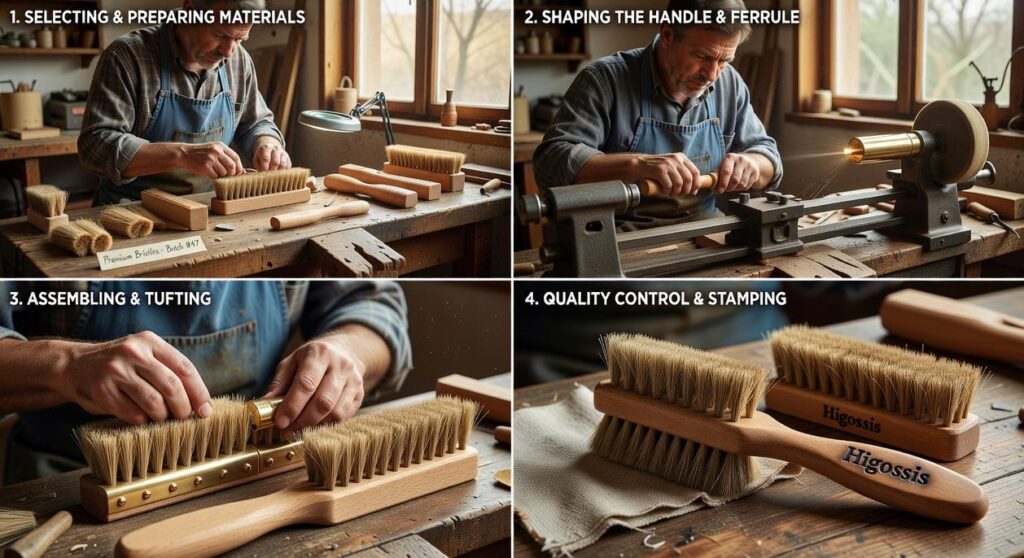
I get asked this question more than any other: what makes a Higossis brush different?
The answer isn’t in the marketing. It’s in the process.
Most people think a brush is just bristles attached to a handle. But there’s a reason some brushes feel like an extension of your hand while others shed after three uses.
I want to show you exactly how a Higossis brush is made. Not the glossy version. The real one.
We’re talking about a multi-step process that combines precision engineering with old-school craftsmanship. Every brush goes through the same rigorous journey before it reaches you.
I’m pulling back the curtain here because you deserve to know what you’re paying for. From the moment we select raw materials to the final quality check, there’s intention behind every decision.
This article walks you through the entire manufacturing process. You’ll see why certain materials get chosen over others. Why some steps can’t be rushed. Why quality control matters more than speed.
By the end, you’ll understand what separates a high-performance brush from one that just looks good in photos.
Step 1: The Foundation of Quality – Sourcing and Selecting Raw Materials
How does Higossis brush made? It starts way before assembly.
Most brush companies won’t tell you where their materials come from. They’ll talk about “premium quality” and leave it at that.
I don’t work that way.
Every Higossis brush begins with three components. Each one matters more than you’d think.
The Bristles: Our Core Component
We use proprietary synthetic fibers. Not because they’re cheaper (they’re not). Because they perform better.
These fibers are 100% cruelty-free and hypoallergenic. You won’t find animal hair here. What you will find is engineered precision that picks up product beautifully and releases it exactly where you want it.
The fibers don’t absorb product like natural bristles do. That means less waste and better application every single time.
We grade every batch for softness and filament integrity. If it doesn’t meet our standards, we don’t use it.
The Ferrule: Engineering for Durability
That metal band holding everything together? It’s double-anodized aluminum.
Scratch-resistant. Rust-proof. Built to keep the brush head secure for years.
Most brushes start shedding bristles after a few months because the ferrule fails. Ours doesn’t.
The Handle: Ergonomics and Balance
We source our wood sustainably and kiln-dry it to prevent warping.
But here’s what really matters. The weight distribution. The shape of the handle in your hand.
A brush that feels awkward throws off your entire application. We engineer for balance so you have complete control.
That’s the foundation. Everything else builds from here.
Step 2: Crafting the Brush Head – Where Artistry Meets Precision
This is where things get interesting.
Most brush companies will tell you their process is special. But when you actually look at what they do, it’s just mass production with fancy marketing.
I’ve watched how does Higossis brush made and I can tell you it’s different.
The weighing process alone separates good brushes from garbage.
Every single brush head gets measured to the exact gram. Not close enough. Not approximately. Exact.
Why does this matter? Because when you pick up a brush six months from now, it needs to feel identical to the one you bought today. That consistency only happens when someone actually cares about the numbers.
Here’s what happens next.
An artisan takes those measured bristles and shapes them by hand in a custom mold. And this is the part that most people get wrong.
They never cut the tips.
Never.
Cutting bristles is faster and cheaper. But it destroys the natural taper of each fiber. That’s why cheap brushes feel scratchy and don’t blend worth a damn.
When you keep the natural taper intact, you get that ultra-soft feel. The kind that lets you blend without thinking about it.
The shaped bundle goes into the ferrule next. But not with whatever glue was on sale that week. A specialized epoxy bonds those bristles permanently.
I’m talking about the kind of bond that laughs at daily washing.
Then comes the double-crimp technique. The ferrule gets crimped twice. Once around the bristles. Once around the handle.
No wobble. No loose heads. No brushes falling apart after three uses.
Some people say hand-shaping is overkill. They argue machines can do it faster and just as well.
But they’re wrong.
A machine can’t feel when the bristles are sitting just right. It can’t adjust for the tiny variations that happen in natural fibers. That’s why machine-made brushes all feel slightly off.
This step takes longer. Costs more. Requires actual skill.
But it’s the only way to make a brush that works the way you need it to.
Step 3: Finishing the Handle – A Multi-Layered Process

You know that feeling when you pick up a quality brush and it just feels different?
That’s not an accident.
The handle finish on a Higossis brush goes through more steps than most people realize. And honestly, it’s one of those things you don’t think about until you hold a cheap brush next to a well-made one.
The difference is obvious.
Sanding and Priming: Building the Foundation
Before any color touches the wood, we sand each handle multiple times.
I’m talking about working the surface until it’s completely smooth. No rough patches. No tiny splinters waiting to catch your finger (because nobody wants that while doing their makeup at 6 AM).
The wood becomes non-porous through this process. That matters more than you’d think.
Once the sanding is done, we apply a primer coat. This creates a base that lets the final color sit rich and even across the entire handle. Without it, you’d see variations in tone. Light spots. Dark spots. The kind of inconsistency that screams rushed production.
Lacquering for Beauty and Longevity
Here’s where things get interesting.
We apply up to seven layers of lacquer or paint to each handle. Seven. Most brushes on the market get two, maybe three if you’re lucky. I cover this topic extensively in How to Clean Higossis Brush.
Each coat builds on the last one. The color deepens. The surface becomes glass-smooth under your fingers when you hold it.
But this isn’t just about looks.
Those layers create a barrier that protects the wood from everything your brush encounters. Moisture from wet makeup. Oil-based products. The humidity in your bathroom. Even the natural oils from your hands.
The result is a finish that resists chipping when you accidentally drop your brush (and we all do). It’s the reason you can learn how to clean higossis brush without worrying about damaging the handle.
Curing and Branding
After the final lacquer coat, the handles go into a controlled baking process.
The temperature has to be exact. Too hot and the lacquer bubbles. Too cool and it never fully hardens.
You can actually smell the lacquer curing if you’re in the production area. It’s a sharp, chemical scent that fades as the coating sets into that permanent, protective shell.
Once the handles cool, we apply the Higossis name and brush number. This step requires precision because there’s no room for error on a finished surface.
That’s how does higossis brush made at this stage. Layer by layer. Step by step. With attention to details most people never see but definitely feel.
Step 4: Final Assembly and Rigorous Quality Control
Ever wonder how a brush that feels perfect in your hand actually comes together?
This is where everything clicks into place.
The finished handle meets the completed brush head. We bond them permanently. No wiggling. No looseness. Just a solid connection that’ll last through hundreds of applications.
The Final Bond
I align each handle with its ferrule by hand. The fit has to be exact. If the balance is off even slightly, you’ll feel it when you’re blending foundation or sweeping on blush.
We use industrial adhesive that cures for 24 hours. Some manufacturers skip this wait time. They ship brushes before the bond fully sets. (That’s why cheaper brushes sometimes fall apart after a few washes.)
Multi-Point Inspection
Here’s where we get picky.
Each brush goes through a shed test. I run my fingers through the bristles repeatedly, checking for loose hairs. If more than two come out, the brush gets rejected.
We check bristle density by pressing the brush head against a light surface. The shape should spring back immediately. No splaying. No bending that stays bent.
The handle finish gets inspected under direct light. Any scratches or uneven coating? It doesn’t ship.
And the ferrule crimp? I check that it’s tight and smooth. Sharp edges will cut into your fingers over time.
Cleaning and Packaging
Before any brush leaves our facility, we clean it.
A gentle antibacterial wash removes any residue from manufacturing. We rinse thoroughly because leftover cleaning solution can irritate sensitive skin.
Then we reshape each brush head by hand. This is how does higossis brush made to arrive looking salon fresh instead of flattened from shipping.
The final step is protective packaging. Each brush gets its own sleeve. No jumbled bags where bristles get crushed against each other.
Want to know What Are Higossis Brush Made Of from start to finish? That link breaks down every material we use.
More Than a Tool, It’s a Commitment to Craft
You’ve now seen the complete process.
Every step matters. From selecting the right materials to the final quality check, nothing happens by accident.
The difference between an average brush and an exceptional one isn’t one single thing. It’s the sum of dozens of deliberate choices.
Each decision we make is about performance and longevity.
This is how a Higossis brush is made. With intention. With precision. With respect for your craft.
That’s why your brush performs flawlessly and stands the test of time. You can master any look with confidence because the tool in your hand won’t let you down.
We believe the quality of your tools should match the quality of your artistry.
You came here to understand what makes these brushes different. Now you know.
Your next step is simple: Put that knowledge to work. Choose tools that respect your skill and support your vision.
The brush in your hand is more than bristles and a handle. It’s a commitment to doing things right.